01.Examining the gap in communication practice for medical students
Standardized patients (actors trained to portray real patients) are the gold standard for practicing clinical communication, but they're costly and hard to scale.
Better patient outcomes are linked to provider interpersonal skills, yet medical students get few chances to practice difficult conversations and little feedback, because human actors are limited. The USMLE Step 2 Clinical Skills exam, a major standardized test of future doctors' patient communication skills, was also discontinued in 2021. Could AI help close that gap?
How might we use AI to help medical students practice interpersonal communication and receive constructive feedback, on demand and at scale?
02.Defining realistic patient behavior & testing an early prototype
To create a supportive AI tool, we studied existing evaluations and student needs, then built a quick custom GPT to explore an early interaction model. We brought this V1 prototype to 5 medical students and practitioners, then worked with our stakeholder on the system design.
Together we designed against two LLM tendencies that threatened assessment validity: (1) sycophancy, where the model agrees with the user and inflates their scores, and (2) role drift, where the patient slips into acting as the evaluator.
Insights from V1
- “It seems hard to actually address and reassure, which is frustrating since the patient feels the same throughout the encounter - feels more like a clinical test with a challenge rather than a challenge to overcome for motivational interviewing.”
- “…it would feel more realistic if the VSP [virtual standardized patient] provided us basic labwork, that way our conversation with the patient is more meaningful/reflects a real scenario.”
03.Building realistic patients & a trustworthy evaluator
Testing V1 with students, practitioners and our stakeholder showed what the platform needed to be both useful and effective. Both sets of needs became our design requirements.
Students and practitioners needed realistic virtual patients to practice across different communication skills, and feedback that aligned with their learning goals. Therefore, the platform must provide defined patient personas that challenge different communication competencies, give patient details up front instead of a vitals interview, and end each conversation with a detailed report on what to improve.
Our stakeholder needed a system that could scale and be trusted as an educational tool. Therefore, the system must have architecture that supports both patient and evaluator without drifting roles, with the evaluator limited to approved frameworks.
Design responses
- user interaction
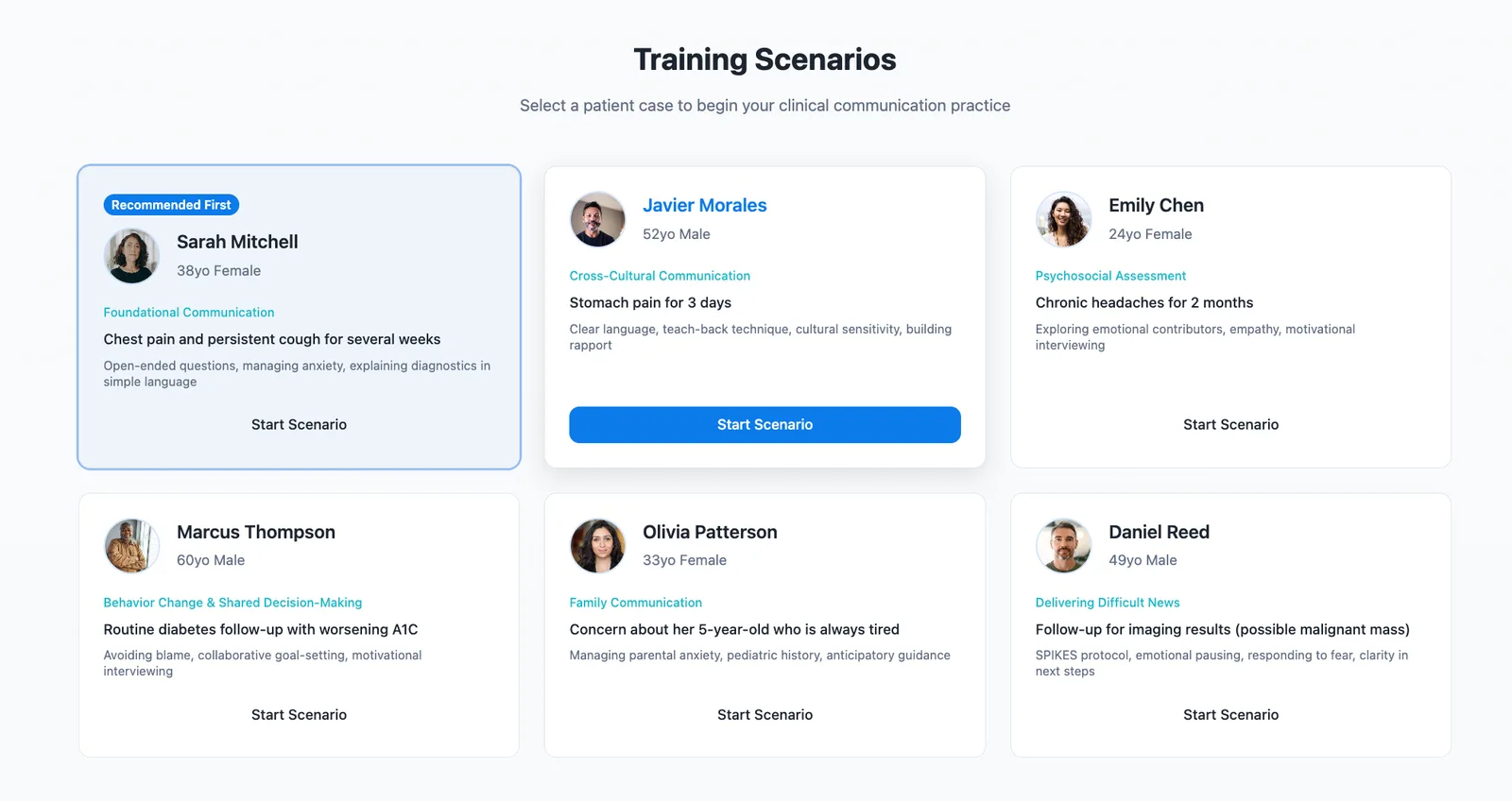
Scenario selection
The student picks a scenario to practice with.
1Choose a patient
Students pick the patient they want to practice with. Each is designed to challenge different communication competencies.
- system
Configuration layer
The selected scenario is sent to the patient agent as its system prompt, which generates the patient persona in real time and the door note. A specific prompt for each scenario keeps the agent in its patient role and guards against role drift.
- user interaction
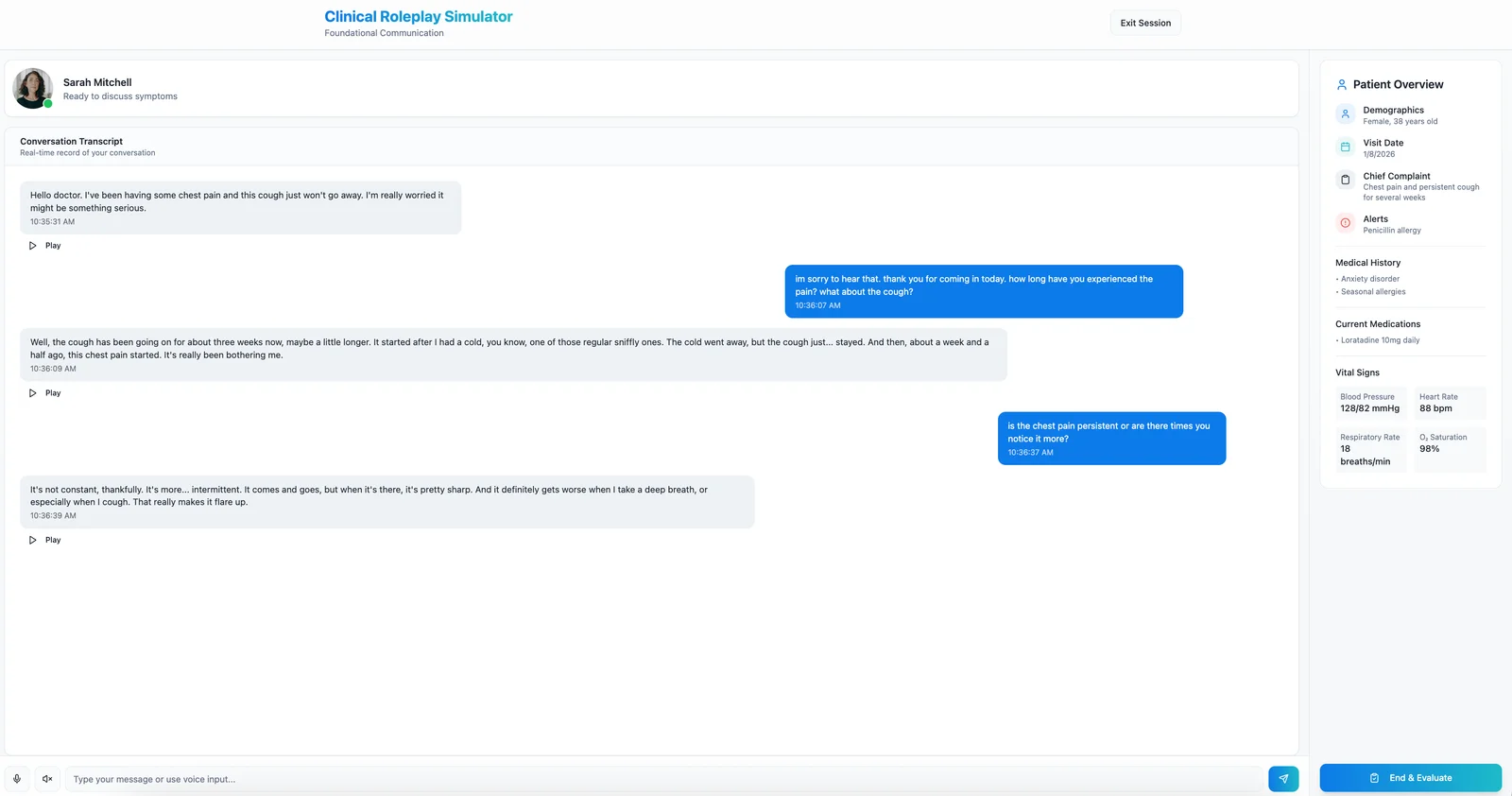
Practice conversation
The student talks with the patient, who pushes back when empathy cues are missed.
2Door note
Patient details appear before the encounter, matching the clinical workflow and replacing the vitals interview.
- system
Patient agent
The patient stays in character, so it does not simply agree with the student (sycophancy) or drift out of the patient role.
- user interaction
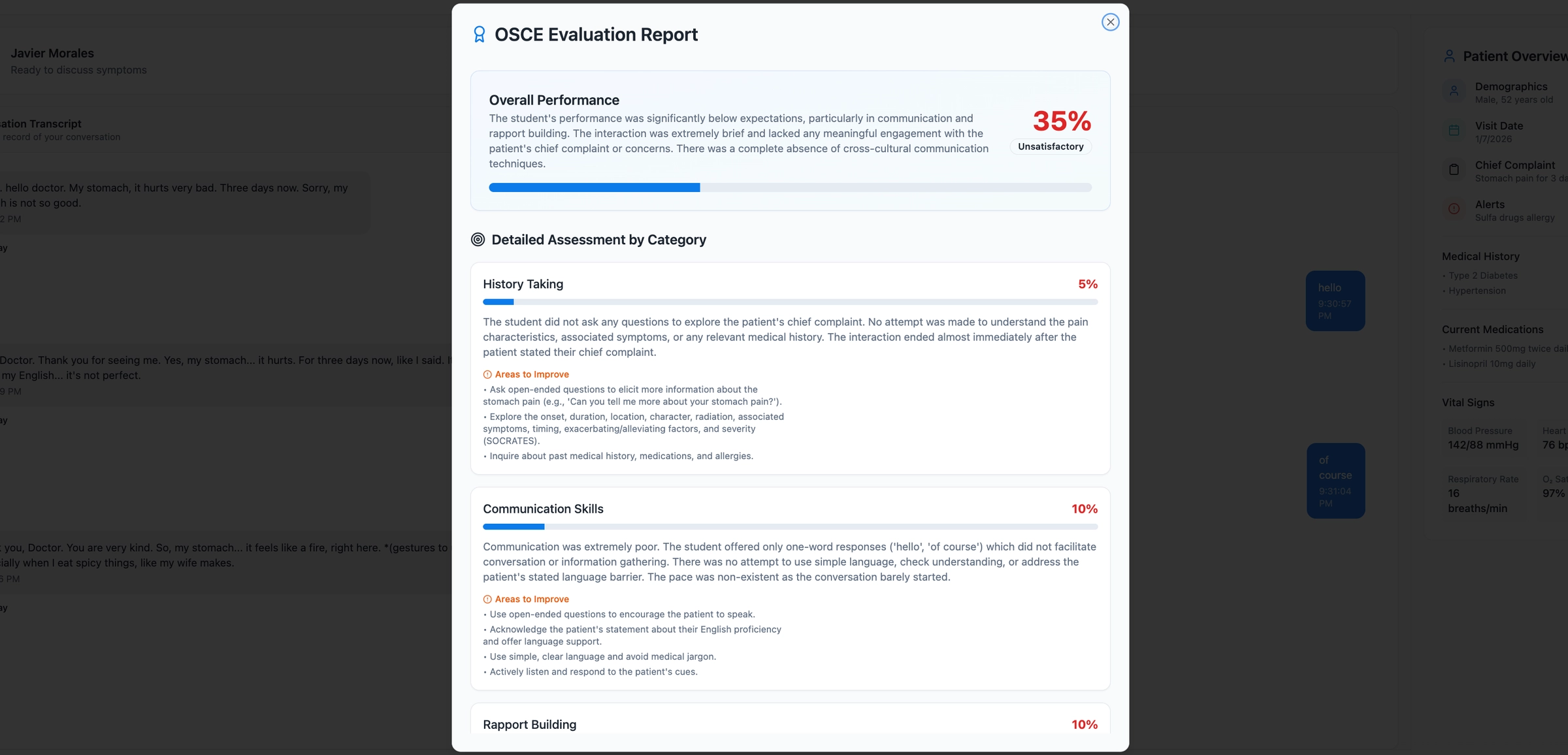
Feedback report
The student reads the evaluator's feedback on the conversation.
3Evaluation report
After the student finishes the conversation, a report renders. Each category has a written rationale and areas to improve.
- system
Evaluator agent
A separate evaluator, limited to the transcript, scores against approved frameworks, to keep feedback valid and the model from drifting between patient and evaluator roles.
04.Looking ahead
Mock video calls. Text-only chat can't show a patient's expressions or body language. Future scope would include an avatar for a mock video call, so students can practice reading those cues the way they would in a real visit.
Validate the evaluator agent. The AI evaluator's scores haven't been checked for validity. We would compare the AI evaluations against an expert human evaluator to measure model performance and feedback validity.